


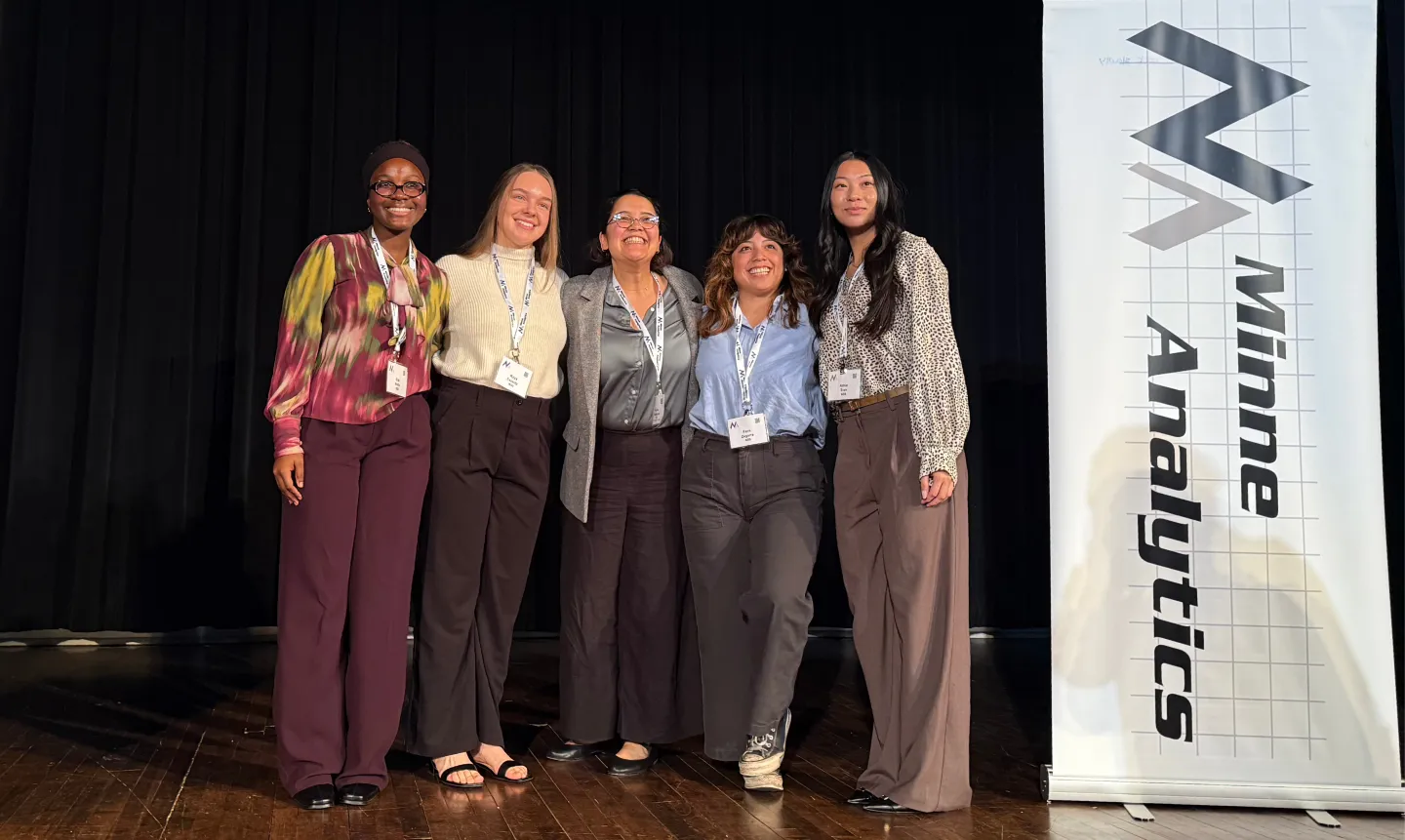
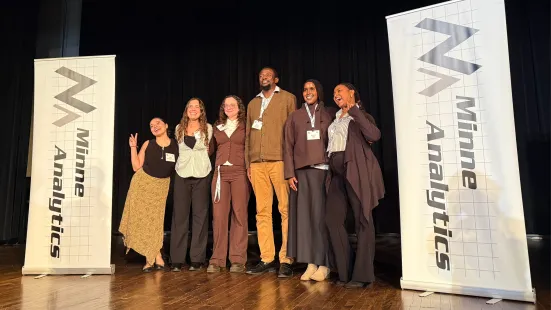
Karine Belarmino Lourenco de Silva, PhD, celebrates with a team of St. Kate's students at MinneMUDAC 2026, held at St. Catherine University in October.
St. Catherine University hosted students and faculty advisors from around the region and as far away as Boston on October 17 for MinneMUDAC 2026, the Midwest Undergraduate Data Analytics Competition organized by MinneAnalytics.
This year’s experiential learning challenge centered on The Food Group, a Minnesota nonprofit working to address food insecurity. The Food Group provides food to the St. Kate’s/CSJ Food Access Hub and to many other Minnesota colleges and universities. Fifty-eight teams, made up of 229 students, analyzed real-world data to identify patterns, generate insights, and develop recommendations for the Food Group. They presented their conclusions to analytics industry professionals and professors, who volunteered as judges.
“MinneMUDAC gives students a valuable opportunity to apply what they have learned, present their work, and engage with professionals beyond the classroom,” said Bethlehem Gronneberg, PhD, who served as a competition judge and is director of the data science program in the School of Liberal Arts, Business and Leadership. “We were pleased to host the competition at St. Kate’s this year and to see students use data to address an issue as important as food insecurity.”
Emma Holden ’27, a data science and psychology double major at St. Kate’s, was part of the team that received The Food Group’s Serendipity Award for an unexpected and meaningful finding: Minnesota counties that overlap with Tribal Nations experience disproportionately high rates of food insecurity.
“The competition was a lot of work, but the experience was well worth it,” Holden said. “Working through the challenges with my team brought us closer together and strengthened the sense of community and collaboration I’ve experienced on campus, in data science, and across related departments.” Holden’s winning teammates included Nesteho Abdi ’27, Betlehem Gebrewolde ’27, Melanie Gravdahl ’29, and Katie Rivas Sanchez ’27.
Ibrahim Soumare, PhD, who teaches the course Predictive Analysis, added, “As the group's advisor, one of the most rewarding parts of this experience was watching students challenge their own assumptions, explore different analytical approaches, and discover insights they had not initially anticipated. Their serendipitous discovery was a reminder that meaningful research is not always about finding what you expect, but about remaining curious and open to what the data reveals.”
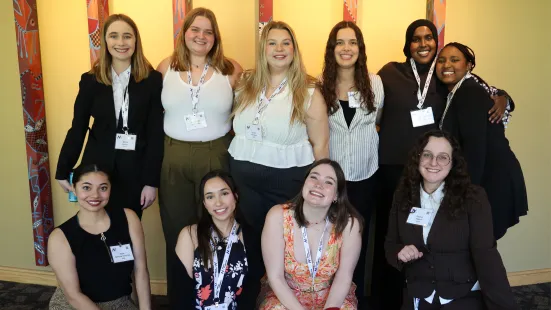
St. Catherine University hosted 58 teams of students from across the region for MinneMUDAC 2026, where they analyzed real data from The Food Group to help address food insecurity.
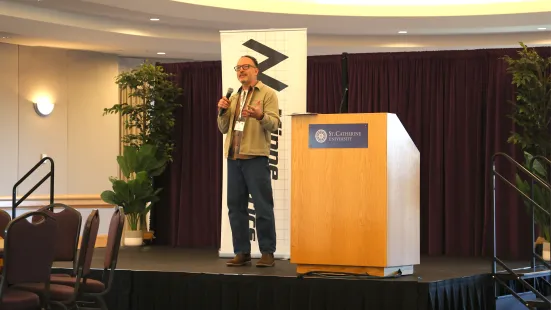
Jim Lesch, of The Food Group, speaks at the student data challenge known as MinneMUDAC 2026, held at St. Catherine University in October.
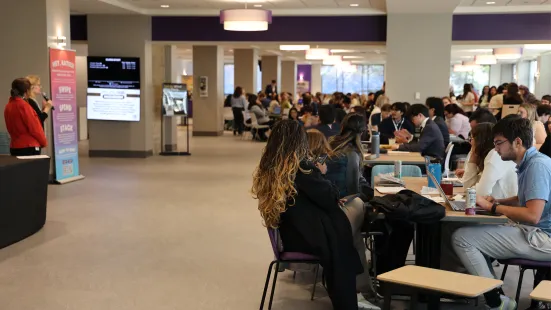
St. Catherine University hosted 58 teams of students from across the region for MinneMUDAC 2026, where they analyzed real data from The Food Group to help address food insecurity.
St. Catherine University hosted 58 teams of students from across the region for MinneMUDAC 2026, where they analyzed real data from The Food Group to help address food insecurity.
A St. Kate’s team from the community-engaged learning (CEL) course, Environmental Economics and Policy taught by Karine Belarmino Lourenco de Silva, PhD, won the novice division.
“Competing in MinneMUDAC really taught me that when you bring together a group of people who care about more than just the numbers themselves, but the people behind them, the work becomes much more intentional,” said Raya Cassidy ’28, an economics major who was part of the novice division–winning team. “Food insecurity is an issue we all need to continue to fight for, and advocate for people who can’t advocate for themselves. I’m very proud of what my group accomplished!” Cassidy’s teammates included Amie Tran ’28, Ella Brefo ’28, and Fern Zegarra ’28.
“Hosting the 7th annual MinneMUDAC Student Data Challenge was truly an honor for us,” said Denise M. Baird, PhD, provost and senior vice president.
The competition lives out a St. Kate’s mission-centered focus of community-engaged and community-led research, which includes student work in courses designated as Research and Creative Inquiry and Community Engaged Learning, as well as through student employment programs such as the University’s Summer Scholars Program and the Assistantship Mentoring Program through the Office of Scholarly Engagement.
“We witnessed the culmination of each team’s month-long effort to utilize data analytics to address issues of food insecurity in Minnesota. And this shines a light on the core of higher education — that we are a community of lifelong learners committed to applying knowledge and expertise to address real-world issues and serve the common good,” Baird said.