


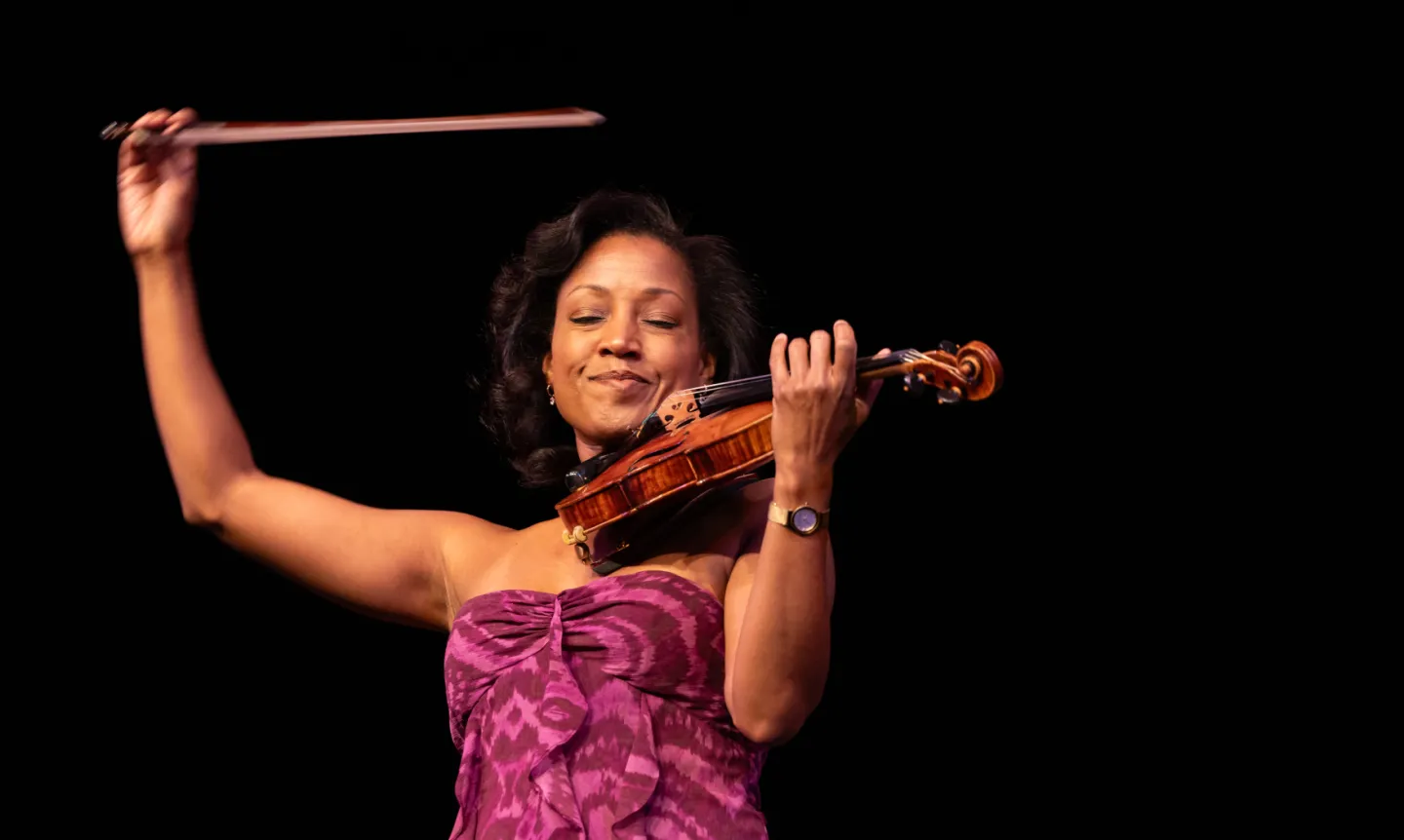
Kelly Hall-Tompkins performed and spoke at The O'Shaughnessy as part of the Women of Color Leadership Series last week.
When she was in elementary school, Kelly Hall-Tompkins knew with startling, singular clarity what she wanted to do with her life. Her goal — being a concert violinist — already seemed unreachable at the age of 9: most classical violinists begin studying the instrument as early as age three. But she stuck with it, practicing tirelessly, seeking out mentors and eventually climbing to the top of the classical music world.
That kind of focused ambition fueling her musical career is just what she wants to inspire in others, Hall-Tompkins told the audience gathered at St. Catherine University’s The O’Shaughnessy auditorium on February 27. Hall-Tompkins performed violin with a quartet and spoke as part of the Women of Color Leadership Series, Katie Leadership Impact programming that showcases high-profile leaders, sharing their stories, talents, and insights, and connecting students with role models who embody the promise of meaningful global change.
“I listened to the voice within myself,” Hall-Tompkins said. “I played for the joy of playing.” Her inner focus and the joy she found in the violin propelled her to the top of her profession. She has won the Naumburg International Violin Competition Prize and the Sphinx Medal of Excellence, and is featured in the Smithsonian’s National Museum for African American History and Culture.
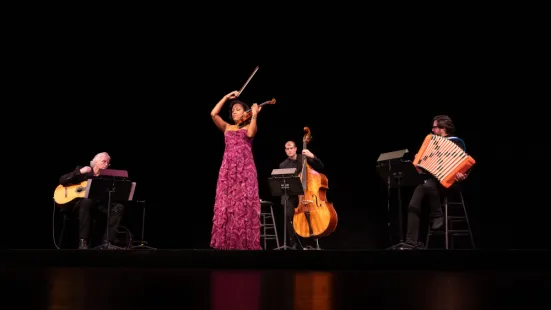
Hall-Tompkins was accompanied by Joshua Camp on accordion, Stephen Benson on guitar, and Michael Blanco on double bass.
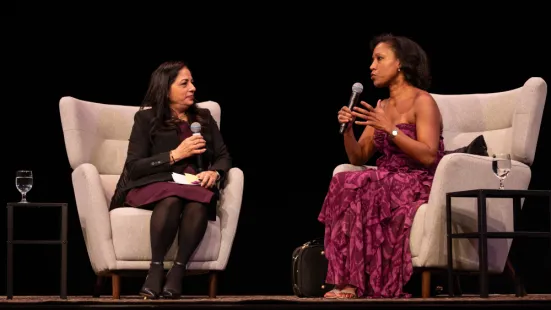
Following her performance, Hall-Tompkins discussed her non-profit Music Kitchen – Food for the Soul with Anupama Pasricha, PhD, President’s Senior Fellow for Leadership Integration (left).
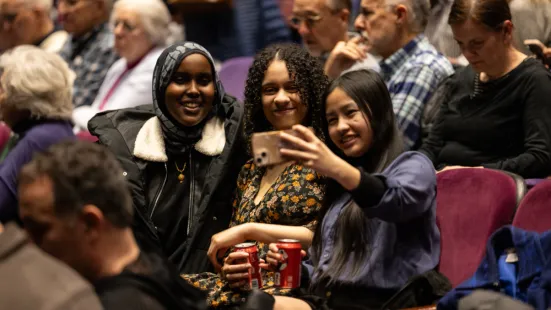
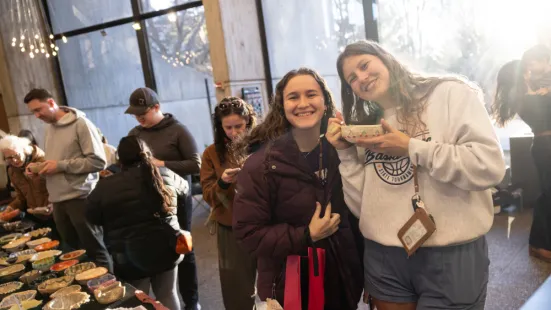
St. Kate's students Nesteho Abdi ’27, Elianna Johnson ’28, and Victoria Lo ’26 (left to right) take a photo together before Hall-Tompkins' performance at The O'Shaughnessy.
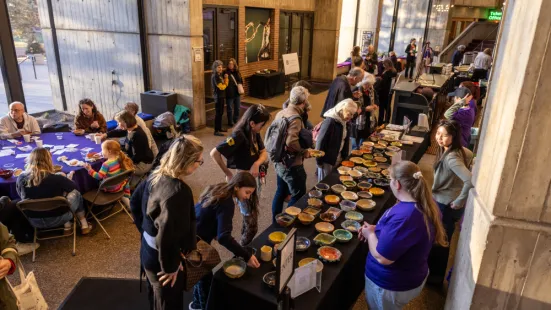
St. Kate's Empty Bowls Project and the St. Kate's Clay Club held a soup social before the event to benefit the St. Kate's/CSJ Food Access Hub.
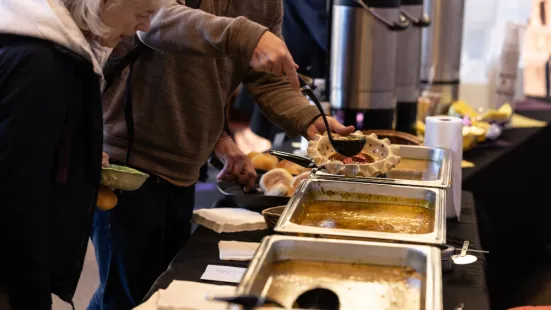
Attendees were served soup in ceramic bowls made by volunteers and were asked to making consider a contribution to the St. Kate's/CSJ Food Access Hub.
Organizer Sara Zafar ’27 said the Empty Bowls event was a perfect match for Kelly Hall-Tompkins' performance, considering the violinists' non-profit, Music Kitchen — Food for the Soul.
In 2016, Hall-Tompkins played the part of the Fiddler in the Grammy and Tony award-nominated 50th anniversary Broadway revival of Fiddler on the Roof. Hall-Tompkins’ Women of Color Leadership Series performance was a review of the Broadway production that included new arrangements of the classic score. At The O’Shaughnessy, Hall-Tompkins was accompanied by an ensemble of three musicians — Joshua Camp on accordion, Stephen Benson on guitar, and Michael Blanco on double bass.
The quartet played masterful, unique renditions of several Fiddler songs, including “Do You Love Me?” and “Matchmaker.” Though the musical was created over half a century ago, its songs capturing struggle, resilience, and community continue to carry lasting meaning for many people, Hall-Tompkins said — adding that productions of Fiddler were continuously performed somewhere in the world from 1964 until the pandemic shut down theaters in 2020. “There is such a broad need in the world for this kind of musical,” she said. “Its message resonates.”
Three St. Kate’s students at the performance — Victoria Lo ’26, Nesteho Abdi ’27, and Elianna Johnson ’28 — said they were moved by Hall-Tompkins’ mastery of her instrument. “She’s such an amazing, accomplished artist,” said Lo, who teared up when Hall-Tompkins performed an original adaptation of “Pure Imagination,” from the 1971 film Willy Wonka and the Chocolate Factory. And when Hall-Tompkins performed a final curtain call, her unique take on Taylor Swift’s “Shake it Off,” Lo, Abdi, and Johnson laughed in recognition as they swayed to the tune.
During a break in the music, Hall-Tompkins, wearing a strapless, flowy dress she said she had selected because it was “St. Kate’s purple,” took a moment to recognize the “great, great, great cities of Minneapolis-St. Paul” and their commitment to their communities. “Thank you for all that you have done,” Hall-Tompkins said. “I see you. The world sees you.”
Her own commitment to helping others in difficult times is evident in Music Kitchen — Food for the Soul, a nonprofit she founded two decades ago that brings emerging and established musicians together to perform for homeless shelter clients in New York City, Los Angeles, and other cities worldwide. She explained that her art propels her activism and her community service, adding that in her work at Music Kitchen, she sees the positive impact music has on shelter clients — and on the classical musicians who play for them. “I continue to be inspired by the energy that music brings,” she said.
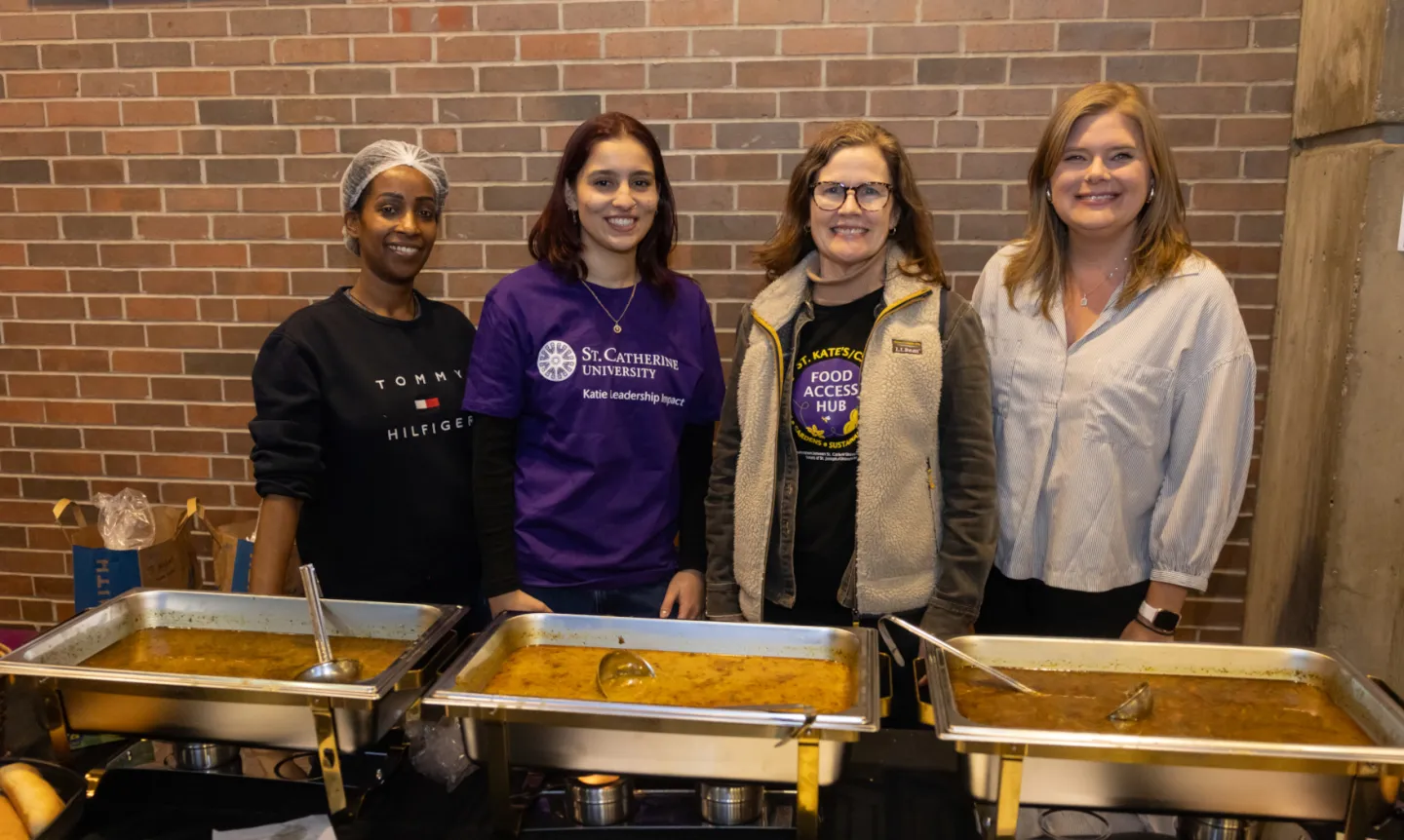
Sara Zafar ’27 (second from left) led this year’s Empty Bowls event in collaboration with the St. Kate’s Clay Club and the St. Kate's/CSJ Food Access Hub.
Soup for the soul
Inspired by Hall-Tompkins and Music Kitchen, St. Kate’s students collaborated with Katie Leadership Impact to support community members facing food insecurity through the St. Kate's Empty Bowls Project, now in its 15th year at the University. Before the performance, student volunteers served soup in bowls created by campus volunteers.
Nursing major Sara Zafar ’27 led this year’s Empty Bowls event in collaboration with the St. Kate’s Clay Club. She said that she and her fellow volunteers felt that the event was the perfect match for Hall-Tompkins’ performance.
“Since her side is music and ours is ceramics, we are mixing our art forms to address food insecurity in our communities,” Zafar said. “We thought it would be a perfect opportunity if we came together to create a joint event.”
In Empty Bowls gatherings, soup and the bowls are offered to guests for free, though community members are asked to make a financial contribution that is then donated to local food-based nonprofits. The proceeds from the Katie Leadership Impact event will go to support the St. Kate’s/CSJ Food Access Hub, a free food and toiletry resource for students and St. Kate’s community members.
Many St. Kate’s students experience food insecurity, Zafar said, and so supporting the Food Access Hub with the Empty Bowls event made sense. “For me personally, seeing how food insecurity has affected so many people in the world is significant,” she said. “I personally use the Food Access Hub. Most of my friends use the Food Access Hub. This is a way I can help in my own community. The experience is valuable to me.”
Photos by Rebecca Zenefski Slater ’10