
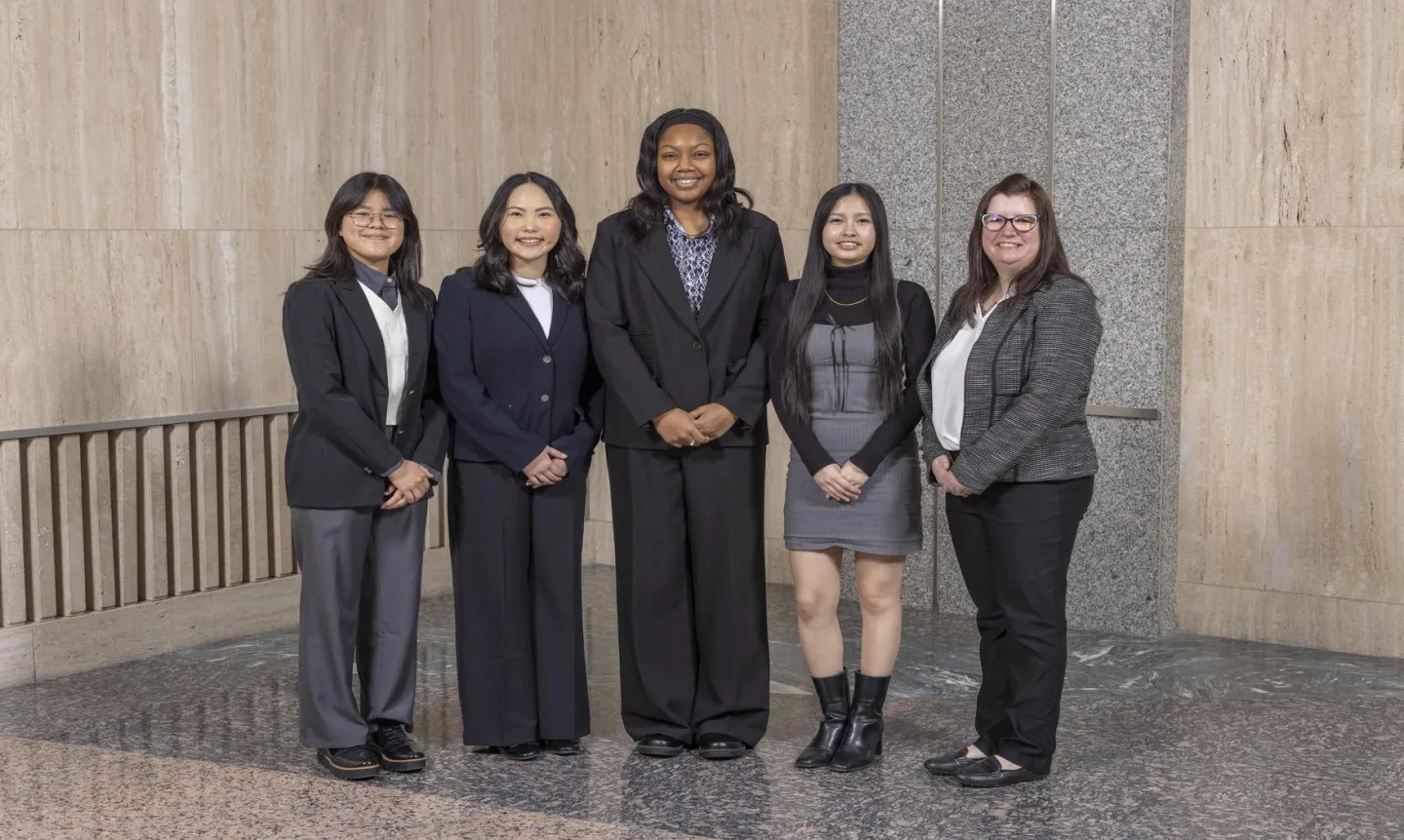
Photo courtesy of Innovation Scholars
In February, the St. Catherine University 2025–26 Innovation Scholars team presented their project recommendations to Mayo Clinic innovators and licensing associates in Rochester, Minnesota, as the culmination of the Innovation Scholars Program.
Working at the intersection of science, healthcare, and entrepreneurship, the multidisciplinary team of four St. Kate’s students spent four months tackling a challenging biomedical tech transfer project in which they analyzed the commercialization potential of 3D printing custom bras to account for natural variations, post-surgical changes, and uneven chest walls.
Innovation Scholars is a nationally recognized experiential learning program that engages teams of liberal arts students in the complex processes of translational medicine, taking an idea "from the bench to the bedside." Project sponsors include Mayo Clinic, early-stage biomedical and healthcare companies, and NASA.
St. Kate’s 2025–26 Innovation Scholars team includes Victoria Lo ’26 (business administration and communication studies), Porkim Minh ’26 (chemistry and biochemistry), Liliana Shortridge ’27 (biology), and Shauna Yang ’26 (economics; minors in psychology and finance). Campus mentors include Lacey Chu, PhD, assistant professor of economics and political science; Tami McDonald, PhD, associate professor of biology; Anupama Pasricha, PhD, President's Senior Fellow for Leadership Integration; and Kristin Tupa, MBA, Master of Arts in Organizational Leadership lecturer. The team is led by St. Catherine University graduate Katie Holloway ’99, MAOL’24, MBA’25.
Since the program began in 2006, 60 St. Kate’s undergraduate alumni have participated on Innovation Scholars teams and 19 MAOL alumni have led IS teams.
“Serving as a mentor in the Innovation Scholars program alongside an exceptional St. Kate's graduate team leader and three other faculty mentors, and contributing as a fashion design expert on this year's project, was deeply meaningful,” said Pasricha. “It reinforced for me that when we invest in students through real-world, interdisciplinary challenges, we are not just shaping their learning, we are shaping the future of leadership.”
“The outcomes were exceptional, but what stayed with me most was the experience's humbling nature,” continued Pasricha. “It was a powerful reminder of what is possible when students are given the space, support, and challenge to rise.”