


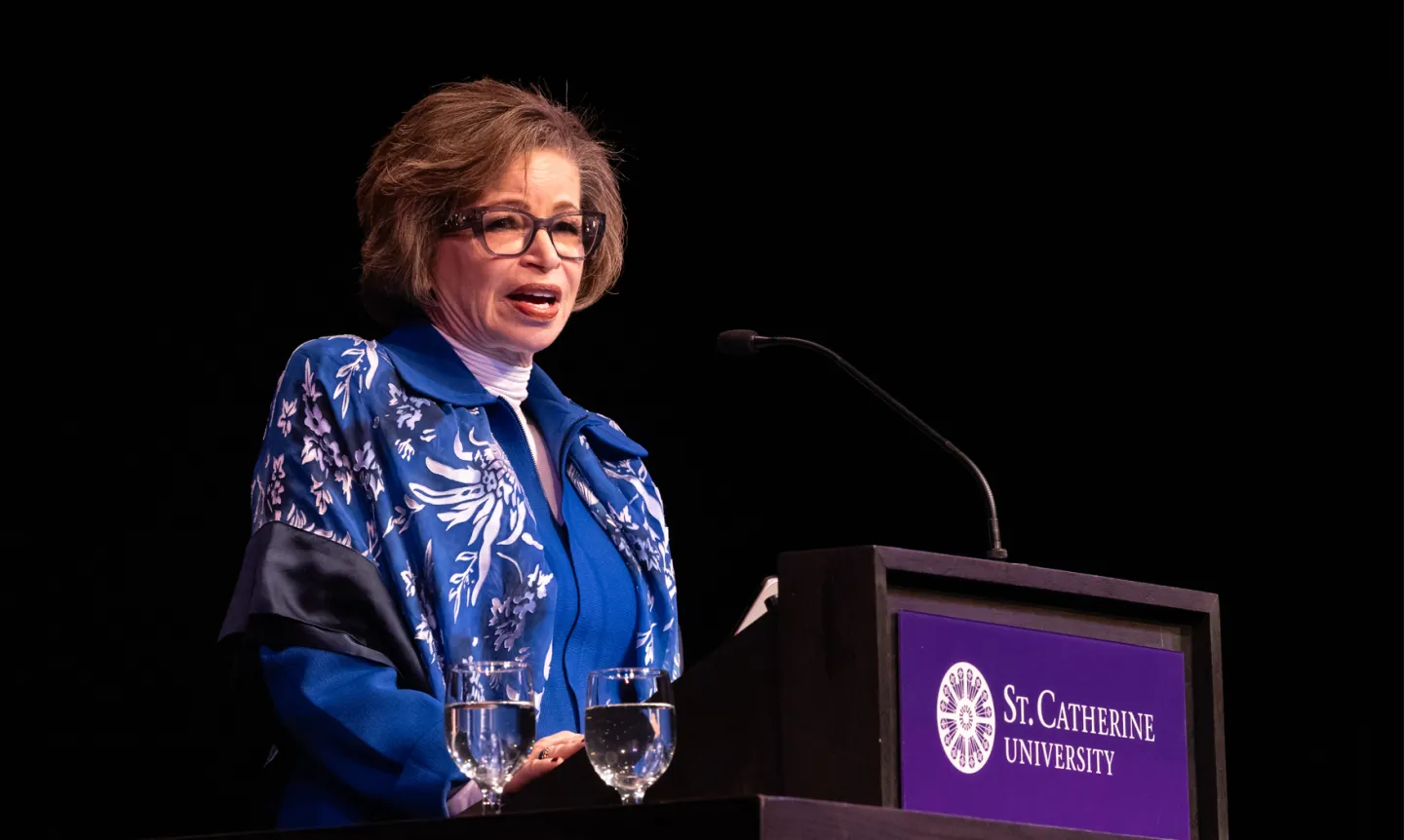
Valerie Jarrett speaks at The O'Shaughnessy. Photo by Rebecca Slater '10 / By Rebecca Studios
On March 5, the Honorable Valerie Jarrett, JD, took the stage at St. Catherine University’s The O’Shaughnessy as the 2026 Bonnie Jean Kelly and Joan Kelly Distinguished Visiting Scholar. Jarrett, CEO of The Barack Obama Foundation, shared stories from her career in politics and advice for those seeking to make a difference.
Jarrett was senior advisor to President Barack Obama from 2009 to 2017, the longest-serving senior advisor to a president in history. She is also the New York Times bestselling author of Finding My Voice: My Journey to the West Wing and the Path Forward. St. Kate’s President Marcheta P. Evans, PhD, introduced Jarrett onstage, saying, “Her work reflects a lifelong commitment to expanding access, cultivating leadership, and strengthening civic engagement. In other words, giving so that others may gain.”
Jarrett began her lecture by acknowledging the reality of Minnesotan daily life for the past few months during the federal government’s Operation Metro Surge. She said earlier that day she met with some of her local friends, who spoke to her of their love for their community.
“I know that many of you have been doing what they’ve been doing,” said Jarrett, “whether it’s delivering food to people who are afraid to come out of their homes, or ensuring safe transport of children to and from school, participating in peaceful demonstrations, [or] opening your hospitals, your houses of worship, your hearts to strangers who live in your community and contribute mightily to your community.”
Such a resolute commitment, Jarrett added, demonstrates one of the greatest lessons she has learned in a life of public service: “Ordinary people, working together with a deep appreciation of the values upon which our democracy was founded, are capable of doing extraordinary things.”

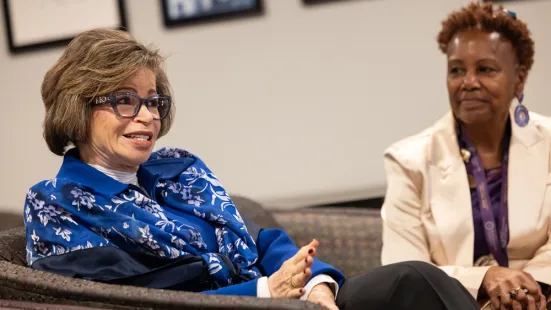
Brandi Powell (left) moderated a conversation with Jarrett.
Photos by Rebecca Slater '10 / By Rebecca Studios

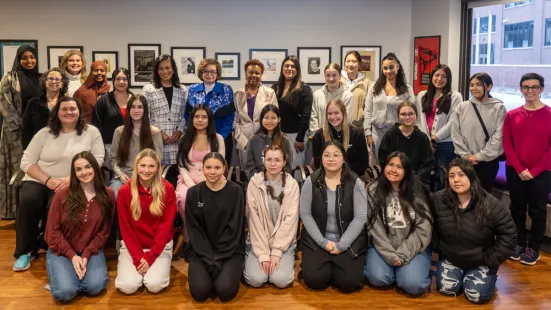
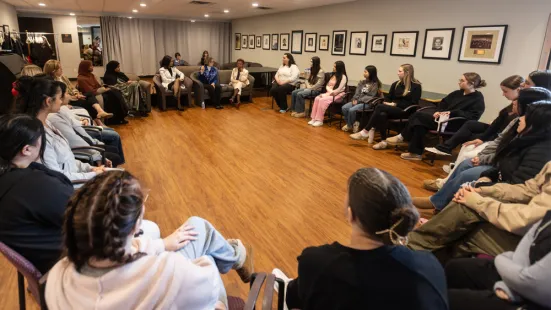
Before her lecture, Jarrett met with a group of St. Kate's students.
“Listen to the quiet voice inside you”
Jarrett was born in Shiraz, Iran, after her parents moved from the United States so her father, a physician, could take a job as chair of the department of pathology at a newly founded hospital. It was an opportunity that was not available to him back home during the Jim Crow era, and it gave Jarrett an early exposure to other languages and cultures. The family lived in Iran until she was five, in a compound for hospital staff where she met children from all over the world and learned to find common ground with people from different backgrounds.
As an adult back in Chicago, Jarrett began her career as a lawyer and then pivoted to working in local government after realizing she was “miserable” in corporate law. She worked as Mayor Richard Daly’s deputy chief of staff, and found the role to be much more fulfilling: “I discovered my voice, not by advocating for myself, but by advocating for people who didn’t have a voice, and I found that extraordinarily empowering.”
While reflecting on her journey, Jarrett shared advice for students considering their own future career paths — and for anyone wondering about their next steps. “What motivates you?” she asked. “You have to do that. You have to listen to the most important voice, which is the quiet voice inside of you, and you really have to develop a sense of resilience and grit and determination.”
Following her speech, Jarrett participated in a conversation moderated by local journalist Brandi Powell of KSTP News, where she discussed the joys and challenges of being a working mother, experiences of imposter syndrome, and memories from the campaign trail with President Obama.
Throughout the evening, Jarrett spoke to the value of sharing personal stories and being authentic — even in professional settings. “It’s just healthier to be open and to be honest and to be vulnerable,” she said. “I think in a different way, women are concerned that vulnerability is a weakness. It’s not. It’s actually a strength. If you have the confidence enough to be vulnerable with somebody, that says a lot about your character and your strength.”
Jarrett acknowledged the difficulty of maintaining hope in hard times, but encouraged the audience to remain committed to the long work of change.
“Our democracy is not self-executing,” Jarrett said. “It is not a spectator sport. It requires every one of us to roll up our sleeves and get involved and to recognize that sometimes change happens quickly — but if it feels like it happens quickly, it’s because of the decades of work that led up to that thunderbolt moment.”
“We don’t necessarily get to be there for the thunderbolt,” she continued. For example, she mentioned, few of the early suffragettes lived to see the passage of the 19th Amendment granting women the right to vote in 1920. “But is there any doubt that, but for their efforts, it would have never happened?”
About the Kelly Lecture
In 2006, alumna Joan Kelly ’46 created the Bonnie Jean Kelly and Joan Kelly Distinguished Visiting Scholars Lecture in honor of her sister, Bonnie Jean Kelly. A successful businesswoman and Phi Beta Kappa graduate in English, Joan (May 22, 1924–Nov. 2, 2016) attended both high school and college on the St. Catherine campus with her sister, Bonnie Jean, who died while a student at St. Kate's.
The other two programs supported include the Bonnie Jean Kelly and Joan Kelly Faculty Excellence Award and the Bonnie Jean Kelly and Joan Kelly Student Excellence in Writing Award.